
Tag: YARD

Announcing YARD-Lint: Keep Your Ruby Documentation Solid

TL;DR: YARD-Lint catches documentation issues, just like RuboCop for code. Star it and use it now.

I am happy to announce the release of YARD-Lint, a comprehensive linter designed for YARD documentation in Ruby and Rails projects. This gem is now available as open-source.

# In your Gemfile
gem 'yard-lint'

For those who are not familiar, YARD (Yet Another Ruby Documentation) is a documentation tool for Ruby that employs structured tags like @param, @return, @raise, and @example to describe methods with precision that machines can read.

Here's an example of linting in practice:

# Reverses the contents of a String or IO object.
#
# @param content [String, #read] the contents to reverse
# @return [String] the contents reversed lexically
# @example
#   reverse("testing" #=> "gnitset"
def reverse(contents)
  contents = contents.read if contents.respond_to? :read
  contents.reverse
end
Inspecting with 21 validators
Found 2 offense(s):

[W] /home/mencio/Software/Mensfeld/demo/test.rb:7
    ExampleSyntax: Object `#reverse` has syntax error in @example '<compiled>:1: syntax error found': > 1 | reverse("testing"
    |                  ^ unexpected end-of-input; expected a `)` to close the arguments

[E] /home/mencio/Software/Mensfeld/demo/test.rb:7
    UnknownParameterName: @param tag has unknown parameter name: content 

I have been using YARD-Lint privately for a few years across all my open-source projects. It has been extensively tested across multiple production codebases and has identified thousands of documentation issues before they were merged. Until now, I haven't had the time to package it properly for public release - life got in the way, as it does.

Documentation Drift

Often I'd refactor method signatures without updating @param tags, return types changed while @return tags stayed stale, new exceptions got raised without @raise tags, and parameters got renamed while docs lagged behind. When I returned to code months later, I'd waste time figuring out what methods actually did versus what the docs claimed.

Since LLM-enhanced coding became part of my workflows, I've also noticed documentation quality directly affects how useful AI assistants are. Well-documented modules? Claude Code nails it quickly. Poor docs? I spend twice as long prompting and fixing. Research confirms this - bad docs cut LLM success rates in half. Even without AI, keeping docs synced matters, but tools like YARD-Lint became way more valuable once AI entered my workflows.

What YARD-Lint Does

A lot. Among other things, it catches:

  • Documentation drift - Undocumented classes, modules, methods, and parameters that should have docs.
  • Type accuracy - Invalid type definitions in @param, @return, and @option tags that don't match valid Ruby classes.
  • Missing context - Methods with options parameters that lack @option tags, question mark methods without return type documentation.
  • Broken examples - Invalid Ruby syntax in @example tags.
  • Semantic issues - @abstract methods with actual implementations, inconsistent tag ordering.
  • YARD parser errors - Unknown tags, invalid directives, duplicate parameters, malformed syntax.

It is RuboCop for your documentation - automated validation that runs in CI and catches problems before they ship (with auto-fixing under development!).

How To Use It

Below, you'll find a step-by-step procedure for installing and configuring YARD-Lint in your Ruby projects.

  1. Add YARD-Lint to your Gemfile

    # In your Gemfile
    gem 'yard-lint'
  2. Install YARD-Lint

    bundle exec yard-lint --init
  3. Run YARD-Lint on your project

    bundle exec yard-lint app/
  4. Configure YARD-Lint using .yard-lint.yml

    AllValidators:
     YardOptions:
       - --private
    Exclude:
     - 'vendor/**/*'
     - 'spec/**/*'
    Documentation/UndocumentedObjects:
     Enabled: true
     Severity: warning
    Tags/InvalidTypes:
     Enabled: true
     Severity: warning

It follows RuboCop's configuration style - hierarchical validators, inheritance support, per-validator controls. You can enable/disable specific checks, adjust severity levels, add custom type definitions, and exclude files per-validator.

Gradual Adoption

It also supports diff linting only, so you can introduce it slowly to your codebase:

Use diff mode to only lint changed files:

# Only check files you modified (perfect for legacy codebases)
yard-lint app/ --diff main

# Or just staged files for pre-commit hooks
yard-lint lib/ --staged

Start small with minimal config:

# Enable just one validator on your newest code
Documentation/UndocumentedObjects:
  Enabled: true
  Include:
    - 'lib/features/new_module/**/*'

Or exclude legacy code:

AllValidators:
  Exclude:
    - 'lib/legacy/**/*'

Start with diff mode on pull requests, gradually expand coverage, then tackle older code during refactoring.

Why Open Source (and why now)

I've kept YARD-Lint private for years while continuously refining it. Although it reached a stable, production-ready state some time ago, life intervened - as it does.

I work extensively with open source projects, many of which rely heavily on YARD for documentation. It's been painful watching documentation quality decline in these projects. Good documentation practices have faded partly because there's no modern, actively maintained validation tool for YARD users.

I've finally carved out the time to properly package this for release. If you're maintaining a serious Ruby codebase, you deserve automated documentation quality checks - just like the automated code quality checks you already have.


References & Further Reading

Ruby programmers/project managers/CEOs Y U NO enforce code quality?

Introduction

This post is a result of recent events with one of the companies that I work with. Sometimes, I help people because I want, sometimes because they pay me, mostly both ;). This time I've been helping one company decide on how to outsource their software development. They have many applications, some of them are old, some of them are younger, they constantly build something new as well - a never-ending story. I didn't want to get into the sole "picking the right company" part of this deal. I was not responsible for financial or any other non-programming part of this process, so instead of recommending companies I focused on something else: How to ensure the same (or better) quality, without having a dedicated team working close to all other people related to a given project.

I've spent some time studying their software, what they do, how they work and what their goals are. Also I've talked with their developers about their feelings and thoughts about all of this. I've spoken to other employees as well, and one thing struck me:

(Obrazek JPEG, 480×480 pikseli)

No one really cares! As long as it works, why would they? Programmers didn't have enough time (and sometimes knowledge), project managers didn't care as long as it worked (or also didn't know how to measure things like that), CEO thought that since there are so many apps, it is impossible to do this without a big overhead (and that this would cost a lot of money).

Low quality is just a way to postpone costs that later will be much higher

I can understand why CEOs can think like that. What I don't understand is why project managers and CTOs don't explain this to them. If CEO doesn't care, no one will be able to. And this will turn against everyone one day. Many poorly written projects are hard to give away. The more complicated they are, the more price grows.

Quality always costs. There's no doubt about that. But if you ensure it from the beginning, the further you go with your project the more you will gain. And I'm not talking only about money. Keep in mind, that people don't like other peoples code. And working with poorly written code is what they hate. Low quality equals a much higher rotation rate in teams that have to work with such code. Also keep in mind that everything changes. Programmers change their jobs, some companies are being closed, some are being created, and if you want to outsource stuff, you need to always be aware of that. The only thing that should not change from your perspective is your code quality.

It's always expensive to transfer knowledge and know-how

Outsourcing is not easy. Your team needs to transfer all the know-how to some other places and people. The more code there is, the harder it gets. But what could you do to make it go faster, easier and cheaper?

Ensure code quality!

You could ensure some code and documentation standards across all the firms that will work on your software. That way you can diversify across few that will be able to work with others code. If all of them share same principals, their work quality should be similar, their code should be readable for all of them and you could rotate across those companies according to your business needs. Further more you could even specify in the contract what you expect and what they need to obtain in terms of quality. Programmers will still make mistakes, things will still not work the way you wanted but even then standards will allow other people to fix those issues without any unexpected impact on the whole project. If you set the standards, programmers will have a bit less freedom in how they work and what they do. It's not always good but it is one of those nonfinancial costs you need to take.

Few tools you can use in order to move forward

Some "code related" tools that can help you out with Ruby based software:

  • Rspec (or any other test framework),
  • Simplecov,
  • YARD,
  • Rubocop.

Rspec (or any other test framework)

This is quite obvious. Tests are must be for any application that we want to maintain. Working with not tested software can be a nightmare. But how to measure tests/specs quality?

Simplecov to the rescue

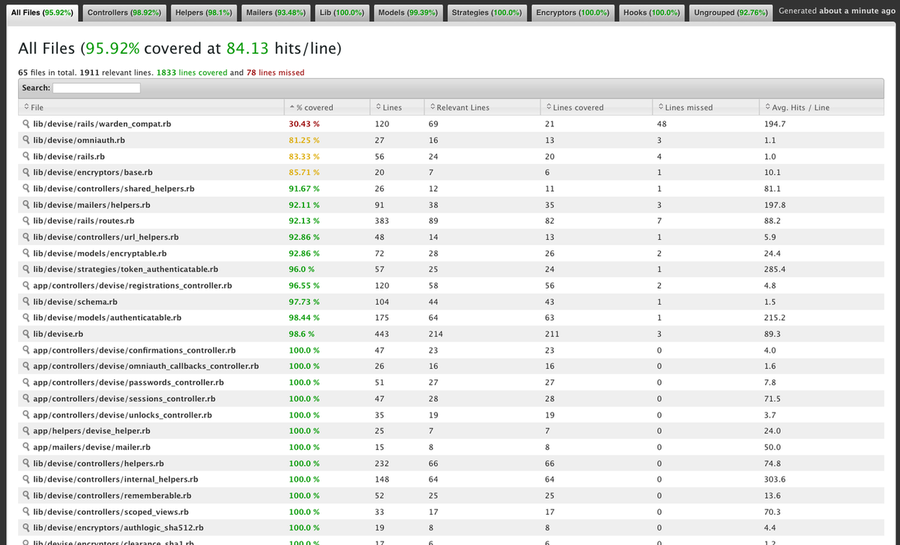
We could (and we should!) use Simplecov. SimpleCov is a code coverage analysis tool for Ruby.

687474703a2f2f636f6c737a6f776b612e6769746875622e636f6d2f73696d706c65636f762f6465766973655f726573756c742d302e352e332e706e67

Picture taken from official Simplecov Github page

It will show you any flaws of your test suites. Not tested classes, methods, cases. It will also generate some useful statistics. If you require usage of this library from your contractors, you can include coverage level as one of parts of your contract. That way they will be obligated to keep tests up and running all the time. Of course they will have to agree on that, because if you force them to use it, they may just write tests that will "pass" Simplecov statistics, delivering you green, low quality tests/specs.

YARD - Yay! A Ruby Documentation Tool

I like self-explaining code. Ruby code can be written both in good and bad way. Unfortunately self-explaining code won't answer all the questions. For example, it won't answer why something is done that way, where there might be a (theoretically) better solution. Also an outsourced code often changes maintainers. None of them will pass all the knowledge to a next one. In cases like that I recommend full YARD documentation. At least on a module/class and public methods level.YARD is a documentation generation tool for the Ruby programming language. It enables the user to generate consistent, usable documentation that can be exported to a number of formats very easily

Some programmers write comments, some don't. But even if they do, without standardization, it's hard to read and maintain. If you use YARD, none of this will happen. You will end-up with a consistent, standardized documentation that can be viewed both online and offline. You can also easily monitor YARD doc coverage level by running:

yard stats --list-undoc

For example, you may get such result:

Files:          21
Modules:         5 (    0 undocumented)
Classes:        25 (    0 undocumented)
Constants:       8 (    1 undocumented)
Methods:        51 (    0 undocumented)
 98.88% documented

Undocumented Objects:

(in file: app/models/credit_card.rb)

Then it is quite clear that in file credit_card.rb some elements are undocumented and that developers should update docs. As you can see, YARD allows us to easily measure and monitor comments quality.

RuboCop - A Ruby static code analyzer, based on the community Ruby style guide

RuboCop is a Ruby static code analyzer. Out of the box it will enforce many of the guidelines outlined in the community Ruby Style Guide. So, instead of having code written in many ways, you can define a file called .rubocop that will contain all the rules about Ruby code style. That way, you can ensure same standards across many applications/dev teams/companies. It will notify you if anything is not as it should be.

.....C.................................................C......................C......

Offenses:

app/controllers/portal/base_controller.rb:40:3: 
C: Cyclomatic complexity for respond_with is too high. [8/6]
  def respond_with(*resources, &block)
  ^^^
app/controllers/portal/base_controller.rb:40:3: 
C: Method has too many lines. [18/15]
  def respond_with(*resources, &block)
  ^^^
app/controllers/application_controller.rb:52:3: 
C: Cyclomatic complexity for respond_with is too high. [8/6]
  def respond_with(*resources, &block)
  ^^^

Summary

Code quality is really important. It's also a topic for more than a blog post, but I hope you will consider this article useful. Tools that I've presented won't replace good developers but they can help you out omit troubles. If you use them wisely, you can ensure similar code quality in many dev teams.

Copyright © 2025 Closer to Code

Theme by Anders NorenUp ↑